
The Forever Book

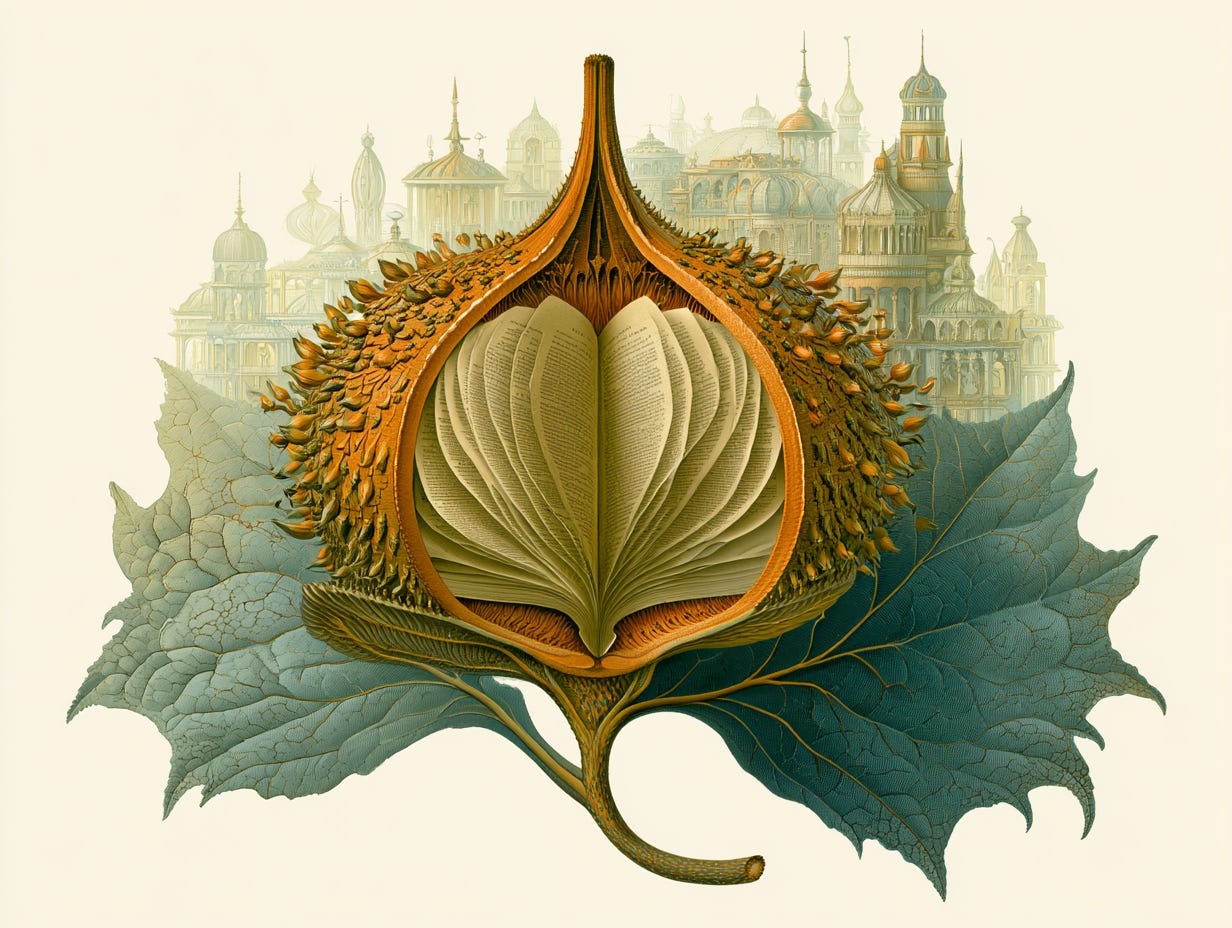
A key idea in cybernetics is the self-reproducing machine: a machine that can make a perfect copy of itself, and importantly, a copy whose copy can itself make a copy. And so on, ad infinitum. We are very familiar with self-reproduction in biology, since that magic trick is the fundamental act of life. Back in the 1950s, while John Von Neumann was helping to invent computers, he was also playing with the idea of artificial self-reproduction, since a computer seemed to have some elements of biology. He began by trying to figure out what the smallest possible self-reproducing machine could be. What was the tiniest man-made thing that could reproduce itself?
Recently biologists have begun to ask a similar question: what is the smallest living thing we can imagine? Out of this line of thinking, researchers on the origin of life have experimented with the smallest possible bits of self-reproducing RNA — which are much smaller than what we find in the wild on earth. Biologists have also constructed a synthetic living cell with fewer genes than any known natural cell.
Life’s solution to minimizing the self-reproduction cycle is to begin with an egg or seed. Compress the full body of an organism into the tiniest lossless version of itself, one that can later unfold into a body able to survive long enough to duplicate via another seed or egg. It is an ingenious solution. Rather than reproduce fully formed, each generation grows (regrows) to its full mature state, while the seed or egg stage carries different survival requirements. Seeds have their own benefits: in dormant mode, they can maintain continuity over very long gaps. Some seeds can remain viable for decades or a century.
I’ve been thinking of civilization as a life form — as a self-replicating structure. And I’ve been wondering: what is the smallest seed into which you could compress the “genes” of civilization, and have it unfold again, sufficiently that it could also make another copy of itself? That is, what is the smallest viable seed of civilization? It must be a seed able to grow to reproduction age and express itself as a full-fledged civilization long enough to have offspring itself.
We know that oak trees can be compressed into acorns, and whales into a fertilized zygote, so I think civilization can be compressed into a library of sorts — a library full of knowledge, and perhaps tools. Many libraries already contain a lot of what we know about our culture and technology, and in the history section even a little on how to recreate it. But a truly self-reproducing library would have explicit instruction in compression and self-reproduction.
It is important to realize that this seed library is not the universal library of everything we know. For that we could just copy everything ever recorded, 1:1. As far as we know, that would work. But it might be the size of the world.
What would be the smallest version of a self-reproducing civilization? This kernel of the technium would not contain a copy of everything we know. Rather, it contains relatively few bits which, when expanded, can recover all that we know. The smallest seed library most likely contains only information, because with the correct information, you can build any tool needed from that information.
The unpacking of a seed like this requires the right environment and the right time scale. In the whale’s case it needs a mommy whale; an oak needs a forest and soil. So the creature is not entirely compressed into the seed alone — it may require an ecosystem as well. But a seed is still a handy thing.
I also believe, though cannot prove, that there is more than one seed. There is likely more than one way to compress and encapsulate the complexity of the technium, just as there is more than one way to fold a protein. We can imagine all kinds of seeds — libraries — that could continue some aspect of civilization by being replanted, rediscovered, or simply renewed. Some may be bigger than others.
So what is the smallest library that could contain the essential bootstrapping notions and knowledge of civilization? The seed must work as a bootstrapping device. As it unpacks itself from the seed phase, early stages form the foundation for the following stages. The initial tools are used to understand the remaining instructions, which are used to create yet more tools and understanding. And so it goes.
In 02014, Alexander Rose, director of the Long Now Foundation, assembled one example of such a seed library. He gathered about 3,000 books selected to contain the information needed to “reboot” human civilization in theory. If civilization were set back significantly, what books would a small community need to reconstruct it? The collection spans practical domains (agriculture, engineering, medicine) as well as the core cultural and intellectual ideas ( literature, philosophy, mathematics) that make civilization worth rebuilding. Plus a whole lot of science fiction to keep the possibilities open. He called this seed the Manual of Civilization.
Such a library would necessarily have to convey, among everything else, how to make a library full of books, since that is in many ways an essential part of civilization. Thus we have the library that can replicate a library which can replicate a library, forever. What is the smallest possible self-replicating forever library?
It is possible that with digital technology it will someday be no bigger than a single book today. And since it contains primarily information, we could think of the self-replicating forever library as a self-replicating book — a Forever Book.
I have been thinking about what it would take to construct a Forever Book, just as an experiment. It would actually be a series of books, each one telling you how to make itself. Each succeeding edition would improve upon the previous one, until the last version contains a full kit: a book that can continue to replicate itself forever.
Here is how the series goes:
Version 1 is a laser-printed book that reprints portions of century-old manuals on how to make paper, how to craft movable type, how to bind books, and so on. It contains general information on how to make another book like itself. (This is the stage I am working at now.) It works at the conceptual level, but may or may not be very practical. Where do you get the metal for the type? Making paper and ink is not very hard, but making type is.
Version 2 is a laser-printed book that has similar information on how to make a book from scratch, but modernized, synthesized, and tested expressly for this project. You might use modern materials and technical shortcuts. The content would be based on the experience of actually making a few books by hand with modern tools. Version 2 contains this information, but it is not itself printed using this technology.
Version 3 is a fully handmade book made entirely by the processes described within it. The information on how this particular book was made is inside the book, and those instructions also serve to make another one just like it. On handmade paper pages it shows you how to make the very page itself; the chapter on ink is printed with ink made by the process shown, and so on. It is a true forever book. Practically, this is a very difficult task to accomplish.
Version 4 is a DVD ( or equivalent) that tells how to make a DVD starting with the skills of a handmade book. I am not certain a DVD is large enough to contain all the knowledge needed to re-create a DVD from elemental materials like silicon, aluminum, petroleum, and copper. There might be a whole shelf of DVDs needed. Or it could be a hard disk of information that contains everything needed to construct another hard disk.
If you keep expanding the notion, you come to a library of DVDs, hard disks, computer networks, and the web that contains all the knowledge needed to replicate the library of hardware and software that holds the knowledge. This seed library is essentially a re-civilization kit — self-replicating knowledge that captures basic civilization skills. It might be very big. At the extreme, the meta-library of all the books and documents on earth today is already a forever library. Surely everything we know includes the information on how to do it again.
But the trick is to encapsulate it into one source — to reduce it to the minimum amount of knowledge required to restart civilization somewhere along the lines of where we are now. What is the least amount of knowledge you’d need to restart the technium in, say, three generations?
One’s definition of technology and civilization will vary, and so there will be many approaches to this seed. This is the fun part. Different priorities will drive different strategies. Some might aim for a seed that restarts fast — a ten-year instant-start pack, maybe designed for a spaceship. Or you might want a civ-seed that unpacks very deeply but slowly, requiring much nurturing yet yielding a very robust technium. Some forever seeds might be designed to produce a very specific type of civilization — one that either avoids or embraces religion, or shifts the notions of gender.
Two other versions of the seed are worth imagining. The “feral” version is a seed able to sprout in a wasteland, with no mommy, no soil: the after-Armageddon version. It must restart civilization with little nurturing, be completely self-evident, and be able to withstand the ignorant. The second is a seed that must sprout to maturity in competition with other emerging forever seeds, or even an already established culture. It must be aggressive, weed-like, and resilient to disruption by other seeds. There might be thousands of ways to unroll a forever book.
This type of curation is, it turns out, the perfect job for an LLM AI. I recently gave Claude the task of selecting a seed library: the best set of books for rebooting civilization from scratch. It curated 200 books across fields as diverse as medicine, metallurgy, and mathematics. It did a remarkably great job. Many of its choices were classics, ones I would have chosen myself. It also pulled in obscure tomes that only a real student of do-it-yourself would be familiar with, and hauled in from far corners some very informative books of practical knowledge I had never heard of. Overall, it accumulated a strong list, among the best I have seen.
However, good as this collection is, there is no way the total sum of information in it — or in any list of books — could serve as a fully self-reproducing machine. This corpus lacks vital practical know-how. The real challenge to constructing a deep Forever Book is that most of the knowledge required to reconstruct technology is never recorded. There is a vast amount of implicit knowledge in an expert’s head which is passed on the factory floor or in the back office and never documented, especially not in a library. You cannot set up a factory to successfully make chips for AI from blueprints alone; failures have shown you need experienced pros in the room to get everything to work. Most modern industrial processes are more art than science. Extracting such fundamental essential knowledge into text at scale may not be possible.
But there are other reasons to try. A Forever Book also serves as a pedagogical device. As Stewart Brand said about the idea of a civilization-scale library: “The appeal here is that every new human, through their education, in effect restarts — or at least rediscovers — civilization.” Trying to assemble and work through the elements of a civilization-restart is potentially the best education there could possibly be.
I don’t imagine many people beside myself being interested in making a Version 3 Forever Book — from my research, it would be a book made from mulberry bark and soot ink, and it’s messy and tedious. But I can imagine many people being interested in making a Version 4 Forever Library. They could spend years carefully studying, selecting, and balancing the content of books, video, music, knowledge, websites, and AIs that would constitute a self-replicating library embedded in modern media. The popularity of lists attests to the appeal of making the Grand List of Most Essential Knowledge.
One could speculate there might be races between libraries — a race to the second generation. The way to win is to be exact enough that someone else could make your book by following your book. I can imagine the Forever Book League, a club whose members have all achieved the following:
Every member has created his or her own version of a Forever Book, which contains instructions for making at least 100 copies of itself.
At least one recipient of those copies has made a second-generation copy.
Enabling a second generation is the gold standard. You don’t have a forever seed unless it has birthed a second generation.
Such a league would encourage communication across generations. A prospective member can’t gain entrance unless they secure evidence that a second-generational participant has succeeded, so the old mentor the young, and the young refine the old. It would be a long, infinite game.
[This is a full revision of a piece I first posted in February 2006.]
Now call me old fashioned, but is not this whole concept somewhat flawed?
If it's reset then we cannot assume an environment as we have. As reset takes time, will there be anyone who can read? Who teaches this knowledge to others & why would the 'old gurad' be let anywhere near those who've managed to survive?
Personally, I'd be wanting find my own way in order not screw up again...
Sorry I find this rather depressing. I'm gonna go out and appreciate what's left of the natural world we already have which is far more amazing that anything our somewhat limited minds can envision. If there are 13 types of intelligence (did I get the number right?) why do we always seem to end up using just one? Cheers.