
An atom’s brief journey through a technological artifact is a flash unlike anything else in its long cold life span. No home is as active for an atom as being in a hot AI chip. For instance, an Nvidia chip contains the highest energy density in the known universe, supplying all the atoms that make it up the fastest ride of their existence.
Most hydrogen atoms were born at the beginning of time. They were created in the fires of the big bang and dispersed into the universe as a uniform warm mist. Thereafter each atom has been on a lonely journey separate from anything material. When a frozen hydrogen atom drifts in the unconsciousness of deep space, it is hardly much more active than the vacuum surrounding it. Time is meaningless without change, and in the vast reaches of cold space which fill 99.9999% of the universe, there is little change.
After billions of years, a hydrogen atom might be swept up by the currents of gravity radiating from a congealing galaxy. With the dimmest hint of time and change it slowly drifts in a steady direction toward other stuff. Another billion years it bumps into the first bit of matter it has ever encountered: another hydrogen atom. After millions of years it meets the second. They drift together in mild attraction until eons later they meet an oxygen. Suddenly something weird happens. In a flash of heat they clump together as one water molecule. Maybe they get sucked into the circulation of a planet. Under this marriage, they are caught in great cycles of change in a proto atmosphere. Rapidly the atom is carried up, and then rained down into a crowded pool of other jostling atoms. In the company of uncountable numbers of other water molecules they travel this circuit around and around for millions of years, from crammed pools to expansive clouds and back. One day in a stroke of luck our water molecule is captured by a chain of unusually active carbon in one pool. Its path is once again accelerated. It spins round in a simple loop assisting the travel of carbon chains. It enjoys speed, movement and change such as could not be possible in the comatose recesses of space. The carbon chain is stolen by another chain, disassembled many times until the hydrogen finds itself in a cell constantly rearranging its relations and bonds with other molecules. Now it hardly ever stops changing, never stops interacting.
The hydrogen atoms in a human body refresh completely every seven years. Our bodies are fancy buckets whose water runs out the bottom as fast as they are being filled up from the top; while we age we are really a river of very old atoms. The heavier atoms in our bodies were produced by other stars. We are, as Carl Sagan so famously said, made of star dust. But the bulk of our body is water, and 2/3 of that (by atom count) is hydrogen. So in fact, we are not star dust, but big bang dust. Much of the matter in our hands, skin, eyes, and hearts was made at the beginning of time, 14 billion years ago. We are much older than we look.
For the average hydrogen atom in our body, the seven years it spends dashing from one cellular station to another will be the fleetingest glory imaginable. Twelve billion years in inert lassitude, and then a brief wild trip through life’s waters, and then on again to the isolation of space when the planet dies. A blink is too long as an analogy. From the perspective of an atom, any living organism is a tornado which might capture it into its mad frenzy of chaos and order, offering it a once in a 12-billion-year-lifetime fling. As fast and crazy as a cell is, the rate of energy flowing through technology is even faster. In fact technology is more active in this respect and will give an atom a wilder ride than any other sustainable structure we are currently aware of, including life, planets, stars and galaxies. For the ultimate trip today, the most sustainable energetic thing in the universe is a computer chip.
To see why, we need a way to actually measure how “alive” a flow of energy is. That measure is called power density: the amount of energy moving through a gram of matter every second. The power density of a star is huge compared to the mild power flows drifting through a nebulous gas cloud in space. But remarkably, the power density of a sun pales to the intense flow of energy and activity present in grass. As intense as the surface of the sun is, its mass is enormous and its lifetime is 10 billion years, so as a whole system, the amount of energy flowing through it per gram per second is less than in a sunflower soaking up that sun’s energy.
A nuclear bomb has a much higher power density than the sun because it is an unsustainable out-of-control flow of energy. The same flame-out applies to well, flames, bombs, supernova and other kinds of explosions. They literally consume themselves with energy. The glory of a star is that it can sustain its brilliant fission for billions of years. But it does so at a lower energy flow rate than the sustainable flux that takes place in a green plant! Rather than a burst of fire, the energy flow in grass yields the cooler order of green blades, tawny stalks, and plump seeds ripe with information that can replicate the entire plant. Greater yet is the energy flow within animals, where we can actually feel their energetic waves. They wiggle, pulse, move, and in some cases radiate warmth.
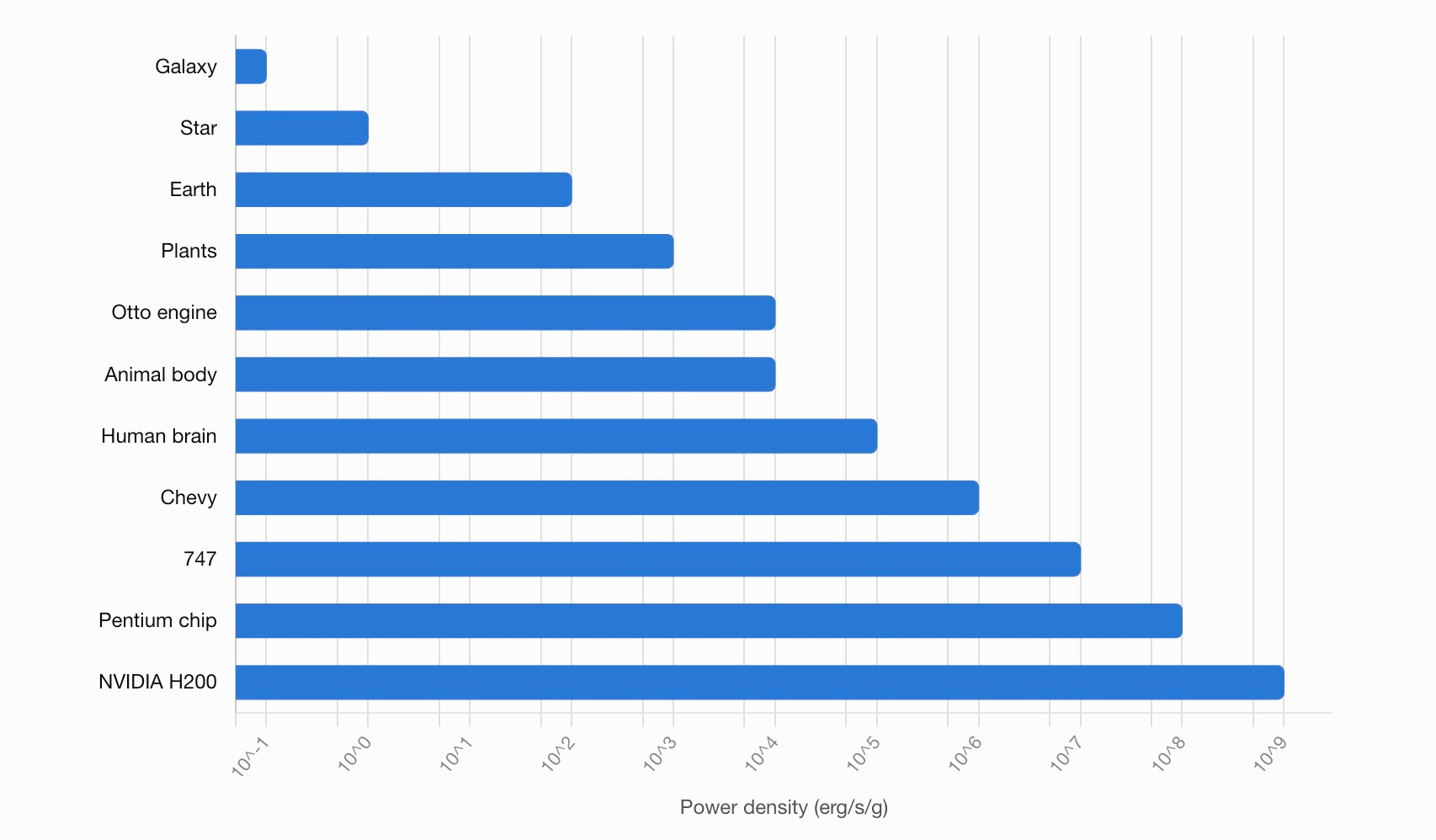
[The stub of this chart began in physicist Eric Chaisson’s “free energy rate density” framework from his book Cosmic Evolution.]
Still greater is the flow of energy through technology. Measured in joules (or ergs) per gram per second, nothing concentrates energy as much as hi-tech gadgetry. At the far apex of the power density graph is an AI computer chip – the most sustainable energetically active thing in the known universe. It conducts more energy (per second per gram) through its tiny corridors than animals, volcanoes, and the sun. It may be better thought of as a very slow nuclear explosion. Another way of looking at this extreme energy rate is to say that the most energetic position for an atom is to be part of a thought, to be captured by thinking.
A 1-megaton nuclear bomb releases about 10^22 ergs — a stupendous amount of power. But the total lifetime of that explosion is a hyper-blink of about a millionth of a second. If you could somehow “amortize” the blast, spending the same energy not in a flash but stretched across say five days (as long as a charged laptop), its power density would settle down to about 10^11 erg/s/g — right in the range of an ordinary laptop chip. Which means the chip in your phone, ounce for ounce, second for second, is already running as hot as a nuclear weapon that’s been slowed down to a five-day burn. Your laptop just never stops.
Indeed the incredibly intense flow of energy required by computation is the major constraint in continual acceleration of small size in silicon computer chips. It is not so much small-scale engineering that is the challenge for future peta-hertz chips as much as it is dispersing the atomic-bomb levels of energy generated in such small places. This is why there is such a tussle over the cooling of data centers. So much energy is focused so intensely in the latest computer chips that they are in danger of simply melting without sophisticated cooling help. MIT quantum computer maven Seth Lloyd performed a calculation to determine the energy needs of the “ultimate laptop” – one that optimized all the atoms contained in one tiny nano-cube of silicon — and figured it would be like having the big bang in your lap. Yeah, it was smart, but boy did it wreck the living room.
Because of the ever-increasing power of smaller chips, only the tiniest femto-fraction of the earth’s atoms will be subjected to this fiery experience. A bit of heavy-duty computation here and there will guide the rest of the materials. But more and more of the mass of atoms will be incorporated into either living systems or technological ones. Four billion years ago, none of the atoms on earth were cycling through cells. Today the biomass of earth totals 10^15 kilograms. The total technomass on the planet (all buildings, infrastructure, vehicles and manufactured goods, etc.) is 10^16 and still expanding. We need only watch the rate of mining and logging to see that more and more atoms are being swept out of their billion-year slumber and channeled into the explosive, dizzy, action-packed, short-lived ride we call the technium.
This transfer is the grand story of the cosmos, in which matter everywhere in the universe is steadily hijacked by exotropic systems. Over the course of cosmic history, atomic particles are gathered by galaxies, combined by stars, cycled by planets, twirled by living cells, and most recently, jiggled and enlivened by technology. These all are self-sustaining systems, with no ends in sight. If one extrapolates, one can imagine that eventually all matter in the universe will someday be touched by these energetic processes at the highest levels of life and technology. According to physicist Freeman Dyson there is sufficient energy and time before the end of the universe for all matter to be encompassed into the intelligent design of technology. Or, as he puts the same thought flipped 180 degrees: there is sufficient energy and time for Minds (AIs) to expand to fill the entire universe. At that moment, all atoms born at the big bang will have, at least once in their long boring existence, been part of a thought.
[I wrote this story 20 years ago, and am reposting it now, along with an update to the newest tech, because it’s still true.]
A mindful universe? I’d say 'sign me up', but if it's already inevitable, then enjoy the ride, my friends.