

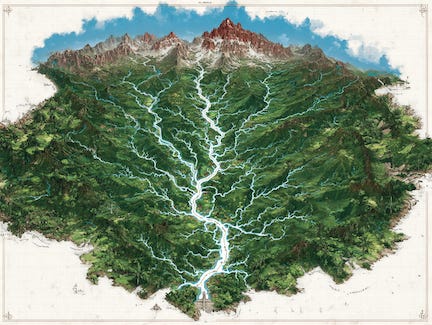
You live in the Big Here. Wherever you live, your tiny spot is deeply intertwined within a larger place, imbedded into a whole system called a watershed, which is itself integrated along with other watersheds into a tightly interdependent bigger system called a biome. All these levels interconnect. At the ultimate level, your place is one cell in a gigantic organism called a planet — the Big Here. What do you know about the dynamics of this larger system around you? Most of us are ignorant of this matrix. But it is the biggest interactive game there is. Engaging it is both fun and vital.
The following exercise in watershed awareness was hatched 50 years ago by Peter Warshall, naturalist extraordinaire, and published in the magazine I edited, Co-Evolution Quarterly. Variations of this list have appeared over the years with additions by Jim Dodge, Peter Berg, and Stephanie Mills among others. In 2003 I added new questions from Warshall and myself, and I edited or altered most of the rest of the questions to make them clearer or more relatable. I posted the revised quiz on my website in 2003; I also published an updated list on page 228 in my book Cool Tools: A Catalog of Possibilities. I am reposting it here with a few new edits and additions. It’s still a work in progress.
How many of these questions can you answer unassisted by Google or AI? If you have difficulty answering them, then by all means ask the machine, and search, and research, to increase your literarcy of the place you call home in the Big Here.
Here are 30 questions to elevate your awareness of the greater place in which you live:
1) Point north.
2) What time is sunset today?
3) Trace the water you drink from rainfall to your tap. Where does your water come from?
4) When you flush, where do the solids go? What happens to the waste water?
5) How many feet (meters) above sea level are you right now? How about your home?
6) What spring wildflower is consistently among the first to bloom here?
7) Can you draw the boundaries of your watershed — which is all the land that drains to a common point on the ocean (like the picture above)? How far do you have to travel before you reach a different watershed?
8) Is the soil under your feet, more clay, sand, rock or silt?
9) Before your tribe lived here, what did the previous inhabitants eat and how did they sustain themselves?
10) Name five native edible plants in your neighborhood and the season(s) they are available.
11) From what direction do storms generally come?
12) Where does your garbage go?
13) How many people live in your watershed?
14) What happens to the paper/plastic you recycle from your neighborhood?
15) Point to where the sun sets on the equinox. How about sunrise on the summer solstice?
16) Where is the nearest earthquake fault? When did it last move?
17) At your home how deep do you have to drill before you reach water?
18) Which (if any) geological features in your watershed are, or were, especially respected by your community, or considered sacred, now or in the past?
19) How many days is the growing season here (from frost to frost)?
20) Name five birds that live here. Which are migratory and which stay put?
21) What was the total rainfall here last year?
22) Where does the pollution in your air come from?
23) If you live near the ocean, when is high tide today?
24) What primary geological processes or events shaped the land here?
25) Name three wild species that were not found here 500 years ago. Name one exotic species that has appeared in the last 5 years.
26) What minerals are found in the ground here that are (or were) economically valuable?
27) Where does your electric power come from and how is it generated?
28) After the rain runs off your roof, where does it go?
29) Where is the nearest wilderness? When was the last time a fire burned through it?
30) How many days till the moon is full?
I am extremely interested in hearing from anyone who scores a 26 or better on the quiz on their first try.
There’s something powerful in this — bringing people back into awareness of place matters.
But I think there’s a deeper contradiction worth exploring.
If we are truly part of a watershed, a biome, a living system… then we’re not separate enough to quiz ourselves about it as if we’re outside looking in.
That framing quietly turns us into observers of something we are continuously shaping.
So the shift might be less about:
“How much do I know about this place?”
And more about:
“What is this place becoming through how I’m living in it?”
Which raises a different kind of question entirely:
Not:
“Can I answer where my water comes from?”
But:
“What am I currently doing to the system that water depends on — and what is it doing back to me?”
Because if we’re embedded, then every action is a contribution.
Every habit is a signal.
Every adjustment is a form of participation.
So maybe the real exercise isn’t answering the 30 questions.
It’s noticing, in real time:
What am I becoming within this system — and is that helping it hold together or pulling it apart?
—
I’ll expand on this in a restack — there’s more here than a comment allows.
I had about 28. I can see how living on a regenerative farm in rural New England would put me more in touch naturally with these things. Fun and important questions though.