
God, the Superposition

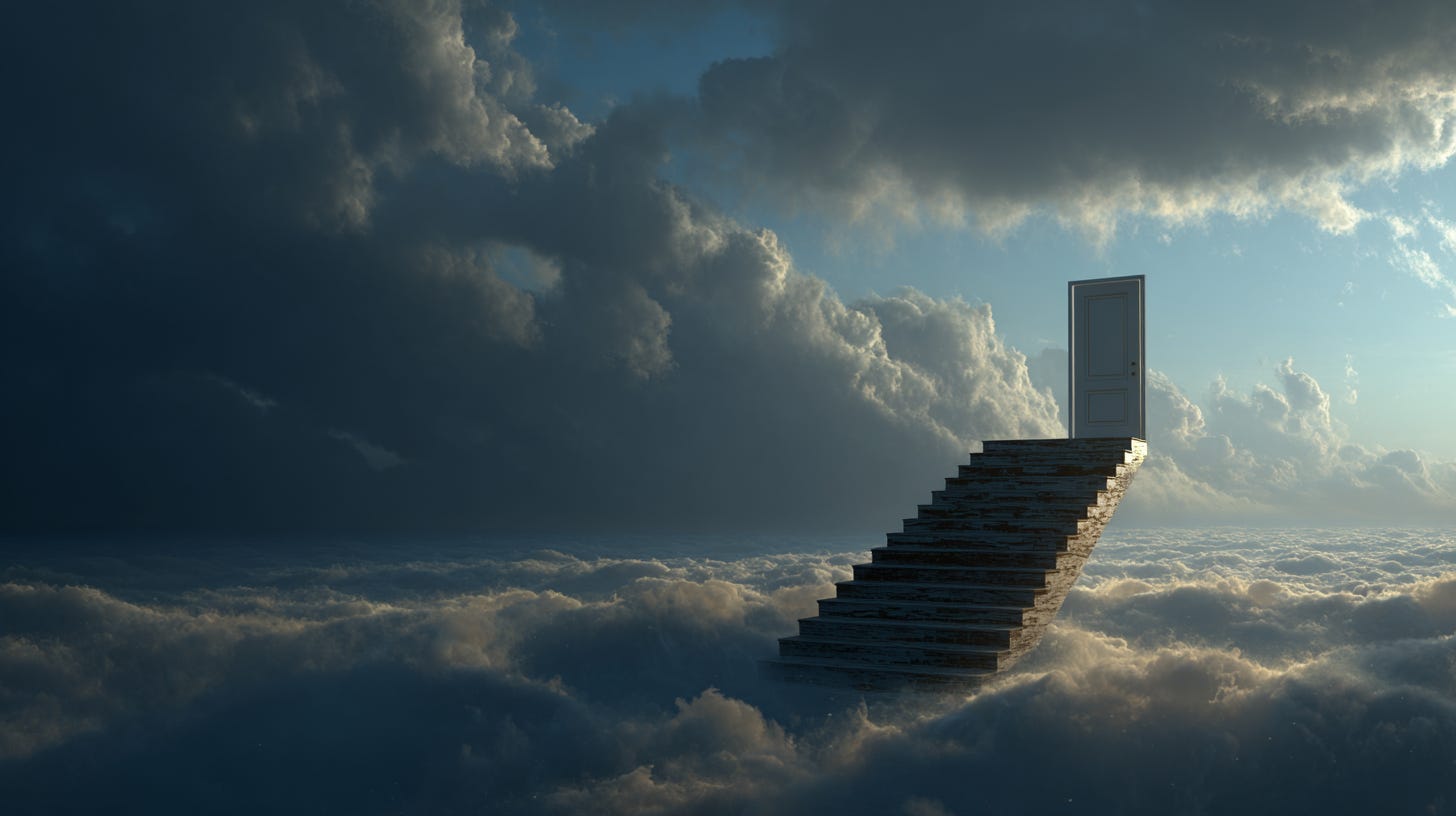
I find any version about the origins of the cosmos to be implausible and unsatisfactory.
The modern scientific view is that the universe began without any creator, it just sort of emerged from nothing by itself. Or it was hatched from a prior universe. Or perhaps the rules of the universe created themselves and then myriad multiverses running on those rules compete to evolve the best universe to birth consciousness. Or the cosmos could be some grand simulation running on computers somewhere, created once upon a time. What made the simulation?
Alternatively, God made the universe (or the simulation). God started it with a big bang and is letting it unfold in its glories. But then the origins of God are likewise unsatisfactory. Even allowing its origins to be outside of time – time being something that is created – the story does not make sense. What was “before” God, if there was no such thing as time before? Maybe nothing has an origin and everything always was. If there is no such thing as an origin —then what is the source of the immense scale and brilliance of everything in the universe?
No matter where we start, we end up with the same illogical notion that there was something that always was, before time, and that everything we understand to be vast and huge and deep was self created from nothing in some way. God, not-God, both are riddled with the same unsatisfying paradoxes.
My current definition of God is: that which is absolutely self-created, with no antecedents, no dependencies, no priors. Might be the universe itself, or might be a personality in the sky. I like to think of God – the self-created core of the cosmos – as a superposition. A superposition is a concept in quantum physics which states that light can be both a wave and a particle, both off and on, present or absent at the same time. A cat can be both dead and alive, and you only notice the difference once you observe it. God/not-God is true at once, and the superposition is only settled once you choose which one to see.
But the paradox of the origin of our universe is only the beginning. The things that we believe are most important in this reality, such as consciousness, free will, and life – all defy common logic. This is not a matter of insufficient knowledge. It is that they don’t make sense because their causation is circular. The more we know about the fundamental structure of the universe, and our minds, and our consciousness, the clearer it is that these things strangely loop back upon themselves like a snake swallowing its tail. Self-causation is illogical because causation itself is illogical. What happened before there was time? What is before the before? What is bigger: something or nothing? How can free will exist in a lawful universe? These are inherent riddles resting upon paradoxes.
This kind of self-causing paradox is not merely inescapable; it is essential. This superposition of beginning/no-beginning, nothing/something, freewill/determinism, God/not-God is the essence of all being; it is paradox itself that generates the unlikely arrangements of all that we consider real and good. You can’t have consciousness without circular self referencing. You can’t have life without recursive feedback loops. You can’t have God without paradoxical self-creation. Anything important, once unraveled, will be resting on a paradox. And without the paradox of superposition, there would be only nothing, instead of nothing and something. There is a necessary paradox at the core of reality.
We have been taught to reject the paradoxical as a disqualification. It is possible that these kinds of paradoxes arise only in our limited human brains trained on superficial logic; perhaps smarter agents won’t be bothered with riddles. Or it might be that these riddles are never erased by any kind mind, and are just something you get used to, something that you expect, and work with. I lean to the latter in absence of any other evidence, and I am learning to embrace the necessary paradoxes that are inherent in intelligences (whether natural or artificial), life (whether natural or artificial), and creations (whether natural or artificial).
As to God/not-God: personally, I choose to see God since it makes a much better story.
This is how I understand it:
Eternal is not equal to forever; it is more like "no time."
Infinite is not equal to never-ending; it is more like "no dimensions."
Time and Space are the concepts we use to process our experience as humans. Like words and language for communication.
"The universe emerges in consciousness," and people like you and me "emerge in consciousness" as well. The body and its senses operate as a localization of consciousness and see its surroundings from a limited perspective (body, mind, psychological patterns).
We identify with the personality and body, an ego, instead of identifying with consciousness, and that is the source of all our problems.
The ancient Rig Veda, whose own origins are unknown and subject to debate which speculations as to its date ranging from 4000 BC to 1200 BC, addresses this paradox.
1) There was neither existing nor non-existing at that time, there was no kingdom of air, nor a heaven beyond it. What was covered, and where? And what provided shelter? Was there water there, unfathomable depths of water?
2) There was no death or immortality, no signs or division between day and night.
That unique, breathless thing breathed by its own nature: apart from it there was nothing at all.
3) There was darkness: in the beginning, hidden in darkness, this All was indiscriminate.
Everything that existed then was empty and formless. Through the great power of heat, that unity was born.
4) From then on, desire arose in the beginning, desire, semen, and the primitive germ of the spirit. The wise ones who have searched with the thoughts of their hearts discovered the kinship that exists in what does not exist.
6) Who knows for certain, and who can declare it here, where this creation was born and where it comes from? The gods came after the creation of this world. Who knows, where they first emerged?
7) [That, whose, this], the first origin of this creation, whether [that, who, this] formed everything or not, Whose eye watches over this world from the highest heavens, [that, who, this] truly knows. Or perhaps [that, who, this] does not know.
(Translation from Wikipedia, but I have replaced in the last verse the word "He" with a more literal and pre-gender translation of the sanskrit word from a Sanskrit dictionary.)